STATEMENT BY THE EGCSA CONCERNING THE ANNOUNCED BAN ON OPEN LOOP MARINE SCRUBBER DISCHARGE BY THE SINGAPORE MPA

STAINES, 4 December 2018 – The IMO legislated to introduce a 0.5 % sulphur cap for all shipping vessels from 2020 with the aim of protecting human health and the marine environment from noxious sulphur dioxide emissions. The shipping industry is reacting responsibly by fitting vessels with exhaust gas cleaning systems (EGCS), so-called marine scrubbers, or by switching to low sulphur fuel.

The recent announcement by the outgoing CEO of the Maritime and Port Authority of Singapore (MPA) banning the discharge of process water from open loop scrubbers for vessels visiting Singapore came without prior notice or discussion with the IMO despite the fact that the Singapore MPA is a signatory to MARPOL Annex VI. The MPA provided neither scientific evidence for its decision nor was the industry invited to consultation. If there had been discussion, the Singapore MPA might have realised the high risks to human health resulting from the high toxicity of low sulphur fuels and more toxic distillates if no exhaust gas cleaning systems are used. The many dumbbell low sulphur fuels (0.50%S fuel oils) are also expected to have less complete combustion as the fuel boiling point distribution and that this will also contribute to higher particulate matter discharge and poorer air quality in Singapore.

Read more

A stamp of quality – customers can expect high standards from EGCSA members

As the 10th anniversary of the founding of the EGCSA approaches, it is gratifying to report around 1,000 globally trading ships have fitted or ordered exhaust gas cleaning systems (EGCS). The figure amounts to 100 ships per year of EGCSA’s existence or about 5 ships per year per EGCSA member.

Clearly the larger companies have the lion’s share of the installations and order book but nevertheless the dogged persistence of EGCSA members will now hopefully provide a return to their investors, no matter the size of the member company. It will not be super-profits. The shipping industry has been spoilt on low cost ships and equipment for too long. That will have to change in a world where steel work will in future have to be complimented by sophistication if the industry is to meet the raft of new environmental requirements.

Read more

Scrubber orders full ahead

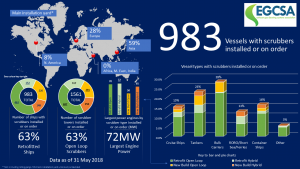
A survey of EGCSA members has revealed that scrubber uptake is rapidly accelerating with the number of ships with exhaust gas cleaning systems installed or on order standing at 983 as of 31 May 2018.

This follows a slew of recent reports that major ship operators, including Spliethoff, Frontline, DHT and Star Bulk have opted for scrubbers. One of the ‘big’ container companies has confirmed it will use scrubbing as part of its 2020 compliance portfolio and there are rumours that others will do likewise.

Until relatively recently the largest installed exhaust handling capacity has been for engine powers in the region of 25 to 30MW. However, the latest data shows that this has been well and truly exceeded by a retrofitted hybrid system for a 72MW container ship engine. Large capacity scrubbers are not confined to retrofits as the maximum size new building installation is a hybrid system for a 65MW engine.

Read more

An inconvenient truth – how the shipping industry’s environmental footprint can be improved.

Time for facts

Season’s greetings from EGCSA!

Looking forward there are now just 24 months until the global 0.50% fuel sulphur limit comes into force and over a year has passed since the industry-changing decision by IMO. Looking back, will 2017 be remembered as the year of fake news? Certainly the term has entered the common language, perhaps more so than the phrase “alternative facts”. The terms are common descriptions of news or information that do not meet the readers’ pre-conceptions.

But why is this relevant to EGCSA?

Read more