A stamp of quality – customers can expect high standards from EGCSA members

As the 10th anniversary of the founding of the EGCSA approaches, it is gratifying to report around 1,000 globally trading ships have fitted or ordered exhaust gas cleaning systems (EGCS). The figure amounts to 100 ships per year of EGCSA’s existence or about 5 ships per year per EGCSA member.

Clearly the larger companies have the lion’s share of the installations and order book but nevertheless the dogged persistence of EGCSA members will now hopefully provide a return to their investors, no matter the size of the member company. It will not be super-profits. The shipping industry has been spoilt on low cost ships and equipment for too long. That will have to change in a world where steel work will in future have to be complimented by sophistication if the industry is to meet the raft of new environmental requirements.

Read more

Scrubber orders full ahead

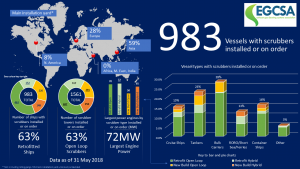
A survey of EGCSA members has revealed that scrubber uptake is rapidly accelerating with the number of ships with exhaust gas cleaning systems installed or on order standing at 983 as of 31 May 2018.

This follows a slew of recent reports that major ship operators, including Spliethoff, Frontline, DHT and Star Bulk have opted for scrubbers. One of the ‘big’ container companies has confirmed it will use scrubbing as part of its 2020 compliance portfolio and there are rumours that others will do likewise.

Until relatively recently the largest installed exhaust handling capacity has been for engine powers in the region of 25 to 30MW. However, the latest data shows that this has been well and truly exceeded by a retrofitted hybrid system for a 72MW container ship engine. Large capacity scrubbers are not confined to retrofits as the maximum size new building installation is a hybrid system for a 65MW engine.

Read more

NOx Reduction by Exhaust Gas Recirculation – MAN explains

egr


When measured in the exhaust duct of a marine diesel engine nitrogen oxide or NOx emissions comprise about 95% nitric oxide (NO) and 5% nitrogen dioxide (NO2), which is formed as NO oxidises after the engine. The formation rate of the majority of nitric oxide is dependent on peak temperatures in the engine cylinders – above 1200oC the formation is significant and above 1500oC it becomes rapid.

Read more

Exhaust Gas Cleaning on YouTube

YouTube header
Courtesy YouTube

Check it out!

YouTube videos of exhaust gas cleaning solutions from EGCSA members: