India

India’s ports and waters are outside of IMO MARPOL Annex VI Emission Control Areas. Under Annex VI regulation 14 the maximum fuel sulphur limit of 0.50% applies from 1 January 2020. Regulation 4 also applies and approved EGCS can be used as an alternative means of compliance.

Engineering Circular No. 02 of 2019 issued by the Directorate General of Shipping 28 August 2019 states in paragraph 5(e):
“Wash water resulting from exhaust gas cleaning systems shall not be led into the sea, including enclosed ports, harbour and estuaries, unless the wash-water meets the criteria set out MEPC 259(68) and applicable local regulatory requirements of the coastal state.”

DGS circulars relevant to MARPOL can be found at https://www.dgshipping.gov.in/Content/DGSCirculars.aspx?branchid=20

03 October 2020

Adani Ports and Special Economic Zone Limited (APSEZ) issued  Circular number: APSEZL/Marine/16/2020, titled Trade Notice 16 Guidelines on Compliance with MARPOL Annex VI, which can be found under Mundra Port downloads at https://www.adaniports.com/Downloads.

The circular confirms that all ships calling Adani Group ports & terminals are advised to strictly comply with DGS Circular 02/2019. In addition with regards use of EGCS as an alternative method of compliance:

  • …vessels fitted with hybrid type of scrubbers should switch over to closed loop mode of operations before entering port limit.
  • Ships fitted with closed loop can continue using the system and ensure that it is in good working order throughout stay of vessel in port.
  • Ships will not be permitted to use the open loop system at Adani ports. Ships having open loop type scrubber should change over to compliant fuel before entering the port.
  • If there is any failure of any of the permitted systems the guidelines and reporting as per the circular needs to be strictly followed.
  • Ships calling Adani ports would be required to submit certification for compliance with the above.
  • Ships may be subject to Port state control inspection for validation of necessary compliance.
  • Above will come in to force w.e.f 1st November 2020.

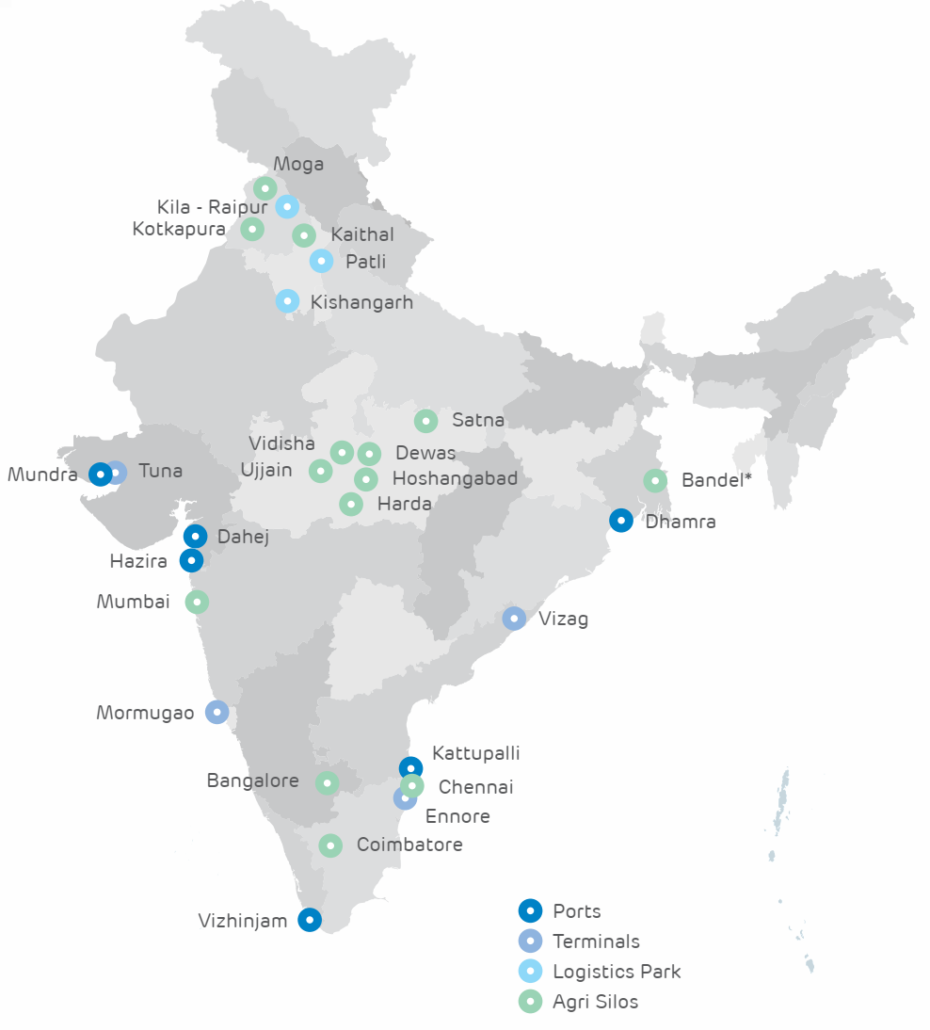
APSEZ currently operates the following 10 domestic ports & terminals in the six maritime states of Gujarat, Goa, Kerala, Andhra Pradesh, Tamil Nadu and Odisha:

  • Mundra Port, Gujarat
  • Tuna Terminal, Gujarat
  • Dahej Port, Gujarat
  • Hazira Port, Gujarat
  • Mormugao, Goa
  • Vizhinjam Port, Kerala
  • Kattupalli Port, Tamil Nadu
  • Ennore Terminal, Tamil Nadu
  • Vizag Terminal, Andhra Pradesh
  • Dhamra Port, Odisha

* It was reported 05 October 20 that APSEZ had completed the acquisition of Krisnapatnam (click to read).

09 October 20 Gulf Agency Company reported that the Port would be subject to the additional guidelines (click to read). Gulf Agency Company subsequently reported 11 November 20 that Krishnapatnam Port Company has issued a Trade Circular revoking the earlier circular dated 6 October banning the use of open loop scrubber systems. (click to read)

Port locations are shown in this graphic from the APSEZ corporate brochure:
Republic of Korea (South Korea)

Republic of Korea (South Korea) Ministry of Oceans and Fisheries has announced that SOx Emission Control Areas (SECA) will be implemented in and around a number of major ports under Article 10(1) of The Special Act on the Improvement of Air Quality in Port Areas.

The ports are:

  • Incheon (including Kyongin Port)
  • Pyeongtaek-Dangjin
  • Yeosu
  • Gwang-yang (including Hadong port)
  • Busan
  • Ulsan

Korean Register Technical Information notice No.: 2020-ETC-06 Date: 9th July, 2020, gives geographic coordinates and maps of the areas. (Click here to view)

  1. From 1st September 2020, ships at berth or at anchor will be required to use fuel with sulphur content not exceeding 0.10%. Fuel changeover is to be within 1 hour of completing anchoring/mooring and compliant fuel must continue to be used until 1 hour before heaving anchor/deberthing.
  2. From 1st January 2022, changeover to 0.10% low sulphur fuel is to be completed at entry into the SECA and use of compliant fuel must continue while the vessel remains inside the SECA.
  3. Alternatively, EGCS (Exhaust Gas Cleaning Systems) compliant with MARPOL requirements can be used providing the reduction in SOx emission is as least as effective as using 0.10% sulphur fuel. There are no restrictions on overboard washwater discharges from open-loop scrubbers.

The Korean Register publication also gives further details on information to be logged if a compliant fuel or alternatively EGCS is to be used and confirms that a written changeover procedure is mandatory if 0.10% sulphur fuel rather than EGCS is the method of compliance.

Downloads of Korean Register rules and technical information can be found in both Korean and English languages at https://www.krs.co.kr/eng/Exclusive/Tech_ETC.aspx?MRID=546&URID=539&TechCode=7


Pakistan

7 January 2020

Pakistan’s ports and waters are outside of IMO MARPOL Annex VI Emission Control Areas. Under Annex VI regulation 14 the maximum fuel sulphur limit of 0.50% applies from 1 January 2020. While regulation 4 also applies and approved EGCS can be used as an alternative means of compliance,  discharges from open loop scrubbers are not permitted in port.

This is confirmed as follows in paragraph 8 of the Ministry of Ports & Shipping (Ports & Shipping Wing) Circular No. 001/2020 circulated by the Port Department of Karachi Port Trust:

8. Prohibition on -discharge of wash-water from Open-Loop Scrubbers in Port:
The discharge of wash-water from open-loop scrubbers is prohibited in Port. While in the Port, vessels fitted with hybrid type of scrubbers should switch to the closed-loop mode of operation. As for vessels fitted with open-loop scrubbers, they would need to switch over to compliant fuel instead. It would be advisable to carry out the switch to either closed-loop mode or to compliant fuel well in advance of the vessel’s arrival at the port waters, so that any operational issues can be identified and. dealt with before the ship arrival in Pakistani waters

The document can be downloaded here.

Japan

A study for the Japanese Government Ministry of Land Infrastructure, Transport and Toursim (MLIT) titled “Report by the expert board for the environmental impact assessment of discharge water from Scrubbers” was published June 2018 (click here to view) and presented to IMO February 2019.

Slide 18 of the presentation, which can be viewed here summarises the study as follows:

  • Scrubbers enable to mitigate potential risks to human health by reducing harmful substances; not only SOx and PM, but also PAHs and other materials that would otherwise be emitted into the atmospheric air.
  • Japanese government assessed the potential risks to marine environment by discharged water from scrubber.
  • Japan concluded that the discharge water with chemical substances such as SOx, PAHs and heavy metals can NOT cause unacceptable effects either on the marine organisms or on the seawater quality around Japan.
  • Therefore, Japan is of the position that there would NOT be a scientific justification to prohibit the use of openlooped scrubber, as long as the IMO’s discharge criteria were met.