Hawaii

Hawaiian waters are part of the North American Emission Control Area and as such MARPOL Annex VI regulation 14 & regulation 4 apply. While discharges from EGCS are allowed, these are subject to conditional Section 401 Water Quality Certification (WQC), the additional requirements of which are given in 2013 VGP section 6.7.

In particular, attention is drawn to the following abridged paragraphs:

6.7.1 ….. conditional Section 401 WQC covers the discharge from an applicable vessel of one or more of the following 27 categories of effluent that have received the best control or treatment into waters of the State of Hawaii…..

6.7.5
(a) Pursuant to HAR, §11-54-4(a), all waters shall be free of substances attributable to the discharge activities authorized under this conditional Section 401 WQC and EPA 2013 VGP…..

(b) Discharges authorized under EPA proposed 2013 VGP shall not cause the applicable specific water quality criteria to be violated in the receiving waters of the State of Hawaii. When conflict occurs, the most stringent limitation applies. Applicable specific water quality criteria are:
…..
…..
(4) HAR, §11-54-6 Uses and specific criteria applicable to marine waters;
(5) HAR, §11-54-7 Uses and specific criteria applicable to marine bottom types;
…..

(c) Parameter and Limitation contained in Table 6.7.1, below, applicable to all discharges from a vessel:
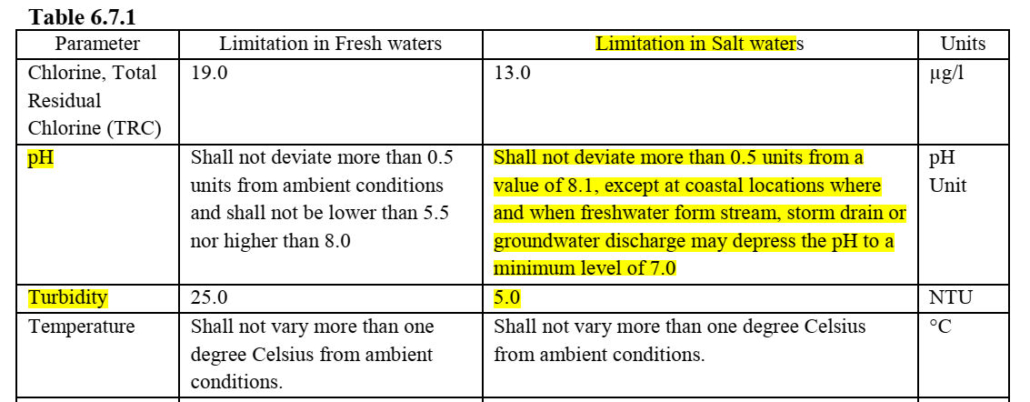
Hawaii Administration Rules Title 11, Chapter 54 (HAR §11-54) can be found here at the State of Hawaii, Department of Health, Clean Water Branch website. Note there is no specific reference to discharges from EGCS in the rules.

Vessel operators should be aware that EGCS (and open loop systems in particular) may not be able to discharge overboard if:

  • The system has no wash water treatment, so the discharge has not received ‘best control or treatment’
  • The discharge cannot meet limits in Hawaii Administration Rules Title 11, Chapter 54 and VGP table 6.7.1

Panama Canal

January 2022

Panama is outside of MARPOL Annex VI regulation 14 Emission Control Areas and therefore the global limit of 0.50% maximum sulphur fuel applies. However, the Panama Canal has specific fuel rules given in OP Notice to Shipping No. N-1-2022 – Vessel Requirements. NOTE: this document is updated annually

Marine Notices for the Canal can be found here https://pancanal.com/en/maritime-services/notices-to-shipping/ and the specific document from the Canal Authority website by clicking here.

Section 32 of the Vessel Requirements requires that vessels arriving at Panama Canal (ACP) waters shall switch their main propulsion engines, boilers, auxiliary generator engines, and other ancillary equipment from residual fuels to marine distillate fuels. Geographic limits of ACP waters are given.

Exhaust Gas Cleaning Systems are allowed but only in Closed Loop – Zero Discharge operation. This is further clarified in section 29(6) which states: “If a Closed Loop Scrubber system is operated during Canal transit, the cleaned bleed-off water is to be retained in a holding tank on board.”

Section 16 states “Arrival of vessels that have been retrofitted with Ballast Water Treatment Rooms on deck and/or Scrubbers have recently become more frequent. In order to minimize the time our boarding officers spend on board to review all the documentation, these vessels are required to notify in advance about such retrofits.” The following conditions from section 32 also apply:

“32e. The type of fuel and scrubber combination intended for use in Panama Canal waters must be uploaded by the vessel’s local agent to the FUEL DECLARATION menu in VUMPA for all vessels arriving to Panama Canal waters. In turn, this information will be verified on the BDN or corresponding fuel analysis report by Panama Canal Boarding Officers upon the vessel’s arrival to Canal waters. Additionally, vessels with approved scrubbers, must have the following information readily available for verification: IAPP Certificate and Supplement thereof, total volume of effluent holding tanks, and logbook entries confirming that effluent holding tanks were emptied prior to arriving to Canal waters.

“32f. The use of open loop scrubbers or hybrid scrubbers in open loop mode is prohibited in Panama Canal waters.

“32g. Vessels making only a local port call and not transiting will not be required to switch their main propulsion engines, boilers, auxiliary generator engines, and other ancillary equipment to marine distillate fuel. These vessels may use marine residual fuel with a maximum sulphur content of 0.5% and viscosity higher than 70 cSt @50 °C or a closed loop scrubber or hybrid scrubber in closed loop and zero discharge mode.”


Connecticut

2013 VGP allows for specific requirements for individual states and Indian country lands. Paragraph 6.5.9 confirms the following. “Discharge of exhaust gas scrubber washwater into Connecticut waters from any vessel covered under the VGP or sVGP is prohibited. This condition is necessary for compliance with CGS section 22a-427, StandardsNo.1, 2, 9, 12, 14, 15, and 24 of the CT WQS.”


California

January 2020

Marine Notice 2020-1 issued by California Air Resources Board is an advisory to “Owners or Operators of Ocean-Going Vessels Visiting California Ports” with a “Reminder of Requirements for Complying with the California Ocean-Going Vessel Fuel Regulation”

The Notice can be downloaded here or viewed at the following link together with other relevant Notices cited below: https://ww2.arb.ca.gov/ogv-fuel-regulation-marine-notices

The CARB OGV Fuel Regulation requires the use of marine distillate grade fuel (marine gas oil or marine diesel oil) with a maximum sulphur level of 0.1% while operating auxiliary diesel and diesel-electric engines, main propulsion diesel engines, and auxiliary boilers on ocean-going vessels within Regulated California Waters (all waters within 24 nautical miles of the California baseline).

It should be noted that the regulation does not allow compliance via scrubbers. Only the low sulphur distillate grades of fuel can be used to comply with the CARB OGV Fuel Regulation.

It not clear why the notice also goes on to say “There is no prohibition on scrubber operation under the CARB OGV Fuel Regulation. However, scrubbers cannot be used in lieu of distillate compliant fuel.

The specific regulations (rulemaking documents) relating to the Notices are:

Fuel regulation exemptions & excluded area

The rulemaking documents give the specific boundaries of where the Fuel Regulation applies and an excluded area, which was shown with a map in a number of Marine Notices including 2011-2. This small region near the north end of the Santa Barbara Channel is excluded from the regulatory boundary to encourage vessels to use the established shipping lanes in the Channel.

There are some exemptions to the Fuel Regulation including:

  • Ocean-going vessel voyages that are comprised of continuous and expeditious navigation through any Regulated California Waters for the purpose of traversing such bodies of water without entering California internal or estuarine waters or calling at a port, roadstead, or terminal facility,
  • For safety reasons (see Marine Notice 2011-5),
  • Payment of non-compliance fees under limited circumstances (see Marine Notice 2011-3); and
  • A temporary experimental or research exemption (see Marine Notice 2017-1)

Sunset Provision

There is also a ‘sunset provision’ (see Marine Notice 2016 -1) which states that the requirements of the California OGV Fuel Regulation will cease to apply if the United States adopts and enforces requirements that will achieve equivalent emissions reductions. However, despite the implementation of the North American Emission Control Area under MARPOL Annex VI Regulation 14, California’s regulation remains in place.