South Africa

South Africa’s ports and waters are outside of IMO MARPOL Annex VI Emission Control Areas. Under Annex VI regulation 14 the maximum fuel sulphur limit of 0.50% applies from 1 January 2020. Regulation 4 also applies and EGCS be used as an alternative means of compliance if at least as effective in terms of SOx emissions reduction as the fuel sulphur limit.

Marine Notice No. 42 of 2020

This is is a supplement to and should be read in conjunction with Marine Notice No.8 of 2019 (see below). The Notice issued by SAMSA 7 September 20 can be viewed in full here.

It provides an “update on the country’s transitional position regarding the use of Exhaust Gas Cleaning System (EGCS) in South African waters, in line with the global implementation of the International Convention for the Prevention of Pollution from Ships (MARPOL) Annex VI limit of 0.50 mass per cent concentration (0.50% m/m) sulphur content in fuel oil, for all ships, effective 1 January 2020.”

Statistics are given on the methods of compliance used by vessels at their first port of call in South Africa, between the period April 2020 and July 2020 (including the various scrubber configurations used).

The Notice confirms that South Africa continues to accept all type approved scrubbers. This position will be re-evaluated following completion of a South African University study on the impact of open loop system wash water discharge on the marine environment. The study is estimated to be finalised December 20.

Marine Notice No. 8 of 2019 and Marine Notice No.22 of 2019 confirm the following key points regarding EGCS:

MN8 (4 March 2019)

3.1 Open-Loop, Closed-Loop Or Hybrid Systems

The use of exhaust gas cleaning systems, also known as scrubbers, is a commercially available option for the shipping industry. Ships installed with scrubbers mean they can continue to burn high-sulphur bunker fuel from 2020 and comply with the 0.5% sulphur limit

The abatement technology works by spraying alkaline water into a vessel’s exhaust to remove sulphur and other unwanted chemicals, either via open-loop system, closed-loop system, or hybrid (open-and-closed loop) system.

The acceptance of exhaust gas cleaning systems (scrubbers) as an equivalent arrangement under Regulation 4 of MARPOL Annex VI for compliance with the sulphur limit is currently based on the criteria stipulated in the 2015 Guidelines for Exhaust Gas Cleaning Systems (resolution MEPC.259(68)).

2015 Guidelines for Exhaust Gas Cleaning Systems (resolution MEPC.259(68)

UNTIL FURTHER NOTICE SOUTH AFRICA ACCEPTS ALL TYPES OF APPROVED SCRUBBERS

The notice can be downloaded from the SAMSA website here.

MN22 (24 December 2019)

Masters of all ships at their first call on any South African port are required to report to SAMSA in the MRCC PAN report, information regarding compliance of MARPOL, ANNEXE, VI (IMO 2020 Sulphur Cap).

There are various options available to a ship owner which will be acceptable to SAMSA

iii)          Ship is equipped with an approved, fully operational Exhaust Gas Cleaning System (Scrubber Unit) and operated in accordance with IMO requirements and guidelines (resolution MEPC.259(68))

Port State Control Officers (PSCO) will require to sight all relevant documents on type of Fuel Oil on board, documents pertaining to the EGCS, evidence that the ship’s personnel involved in the operation of EGCS are adequately trained and familiar with its operation. Such records shall be made available to PSCO’s on request.

Additional information on the EGCS i.e. Make and Type of EGCS installed (Open Loop, Close Loop or Hybrid), frequency and date of Wash Water testing is to be included in the PAN report to MRCC.

Any breakdown or malfunction of the EGCS, notification to be sent to SAMSA

The notice can be downloaded from the SAMSA website here.

All Marine Notices can be downloaded at the following address: http://www.samsa.org.za/Pages/Marine-Notices.aspx

Relevant acts and regulations can be downloaded at the following address:

http://www.samsa.org.za/Pages/Acts-and-Regulations.aspx

The Maritime Zones act defines the boundaries of South African waters
Bermuda

Bermuda’s Environmental Policy for Ships can be found at https://www.gov.bm/environmental-policy-ships

Key (abridged) points for vessels  in Bermuda’s territorial waters include:

1. A ship staying in Bermuda’s territorial waters for a cumulative total of 7 days or longer within one year shall make application for Operating Licences for Controlled Plant……

3. The maximum allowed sulphur content in fuel for Controlled Plants is 2.0%. Ships equipped with Exhaust Gas Cleaning Systems (EGCS) shall seek the prior approval of the Environmental Authority before its use in Bermuda’s territorial waters. Washwater and residue from the EGCS shall be not disposed of in Bermuda or discharged into Bermuda’s waters but shall be stored on board the ship until outside of Bermuda’s waters.

Hawaii

Hawaiian waters are part of the North American Emission Control Area and as such MARPOL Annex VI regulation 14 & regulation 4 apply. While discharges from EGCS are allowed, these are subject to conditional Section 401 Water Quality Certification (WQC), the additional requirements of which are given in 2013 VGP section 6.7.

In particular, attention is drawn to the following abridged paragraphs:

6.7.1 ….. conditional Section 401 WQC covers the discharge from an applicable vessel of one or more of the following 27 categories of effluent that have received the best control or treatment into waters of the State of Hawaii…..

6.7.5
(a) Pursuant to HAR, §11-54-4(a), all waters shall be free of substances attributable to the discharge activities authorized under this conditional Section 401 WQC and EPA 2013 VGP…..

(b) Discharges authorized under EPA proposed 2013 VGP shall not cause the applicable specific water quality criteria to be violated in the receiving waters of the State of Hawaii. When conflict occurs, the most stringent limitation applies. Applicable specific water quality criteria are:
…..
…..
(4) HAR, §11-54-6 Uses and specific criteria applicable to marine waters;
(5) HAR, §11-54-7 Uses and specific criteria applicable to marine bottom types;
…..

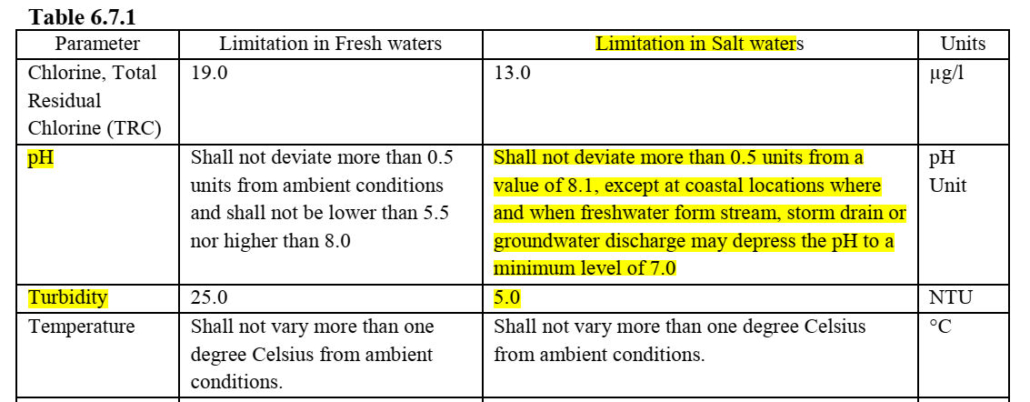
(c) Parameter and Limitation contained in Table 6.7.1, below, applicable to all discharges from a vessel:

Hawaii Administration Rules Title 11, Chapter 54 (HAR §11-54) can be found here at the State of Hawaii, Department of Health, Clean Water Branch website. Note there is no specific reference to discharges from EGCS in the rules.

Vessel operators should be aware that EGCS (and open loop systems in particular) may not be able to discharge overboard if:

  • The system has no wash water treatment, so the discharge has not received ‘best control or treatment’
  • The discharge cannot meet limits in Hawaii Administration Rules Title 11, Chapter 54 and VGP table 6.7.1

Estonia

February 2021

2019 advice below remains valid following confirmation from the Estonian Maritime Administration:

“Using open-loop exhaust gas cleaning systems in Estonian ports are not prohibited, but their washwater must comply with the requirements of the IMO resolution MEPC.184(59).

“In addition, Estonian domestic law specifies (Annex 9 to Regulation No. 73 of the Minister of the Environment):

“Washwater from exhaust gas cleaning systems using chemicals, additives, preparations or relevant cemicals created in situ, as referred to in MEPC.184 (59) paragraph 10.1.6.1, shall not be discharged into the sea, including closed ports, unless the shipowner demonstrates that the discharge of such washwater into the sea does not have a significant adverse effect on or endanger human health or the environment. If the chemical compound used is sodium hydroxide, it is sufficient that the washwater meets the criteria set out in MEPC.184 (59) and has a pH of not more than 8,0”

The last paragraph typically applies to closed loop scrubbing, however this is not specifically mentioned and so it is assumed that discharges from closed loop scrubbers remain prohibited as per the circular below

A copy of the email (contact details removed) courtesy of the Clean Shipping Alliance can be viewed here.

October 2019

Circular No. 4 21.10.19, Clarification of Exhaust Gas Cleaning System (EGCS) operations in territorial waters and ports
of Estonia can be downloaded from the Estonian Maritime Administration website here.

Other circulars can be found at https://www.transpordiamet.ee/en/safety-and-supervision/maritime-safety/estonian-transport-administrations-circulars

The circular confirms advice received from the Adminstration in July 2019 in response to a request for information from an EGCSA member:

“Thank You for the inquiry. Estonian Maritime Administration will make public the official information concerning EGCS (Exhaust Gas Cleaning System) operations in territorial waters and ports of Estonia in due time. With the regulation no. 73 by Minister of Environment Annex 9 the open-loop EGCS is not prohibbited if the systems comply with resolution MEPC.184(59) and other appropriate international regulatory requirements including MARPOL Annex VI. Also it is important that the port authorities will issue approval of using open-loop EGCS in the port area.

The communication with contact details redacted can be viewed here.

It should be noted the circular ends with the following regarding closed loop scrubbers:

“The use of closed-loop EGCS is permitted in the territorial waters and ports of Estonia, provided that it meets the relevant requirements and is certified. Discharging of washing water from closed-loop EGCS is not permitted.